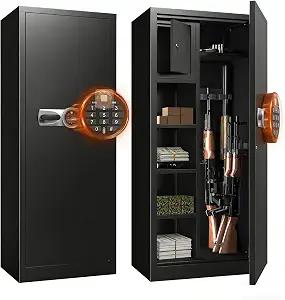
Best Budget Gun Safes: Top Picks Under $500
Discover the best budget gun safes under $500 that balance affordability with security, fire protection, and child safety. From biometric entry to keypad access, find the right gun safe or cabinet for your firearm storage needs.

Written By
Michael Crites
Licensed Concealed Carry Holder
Reviewed by
Editorial Team
Learn About The Editorial Team
Share:
Products are selected by our editors. We may earn a commission on purchases from a link. How we select gear.
Updated
Aug 2026
To create this guide, we tested multiple long gun safes and gun cabinets, researched their security features, and interviewed gun safe experts who understand what actually stops thieves—and what doesn’t survive a house fire.
A critical note upfront: many gun safes are not fireproof. Budget gun safes under $500 typically lack true fire-resistant insulation. Some offer limited one-hour fire protection using basic drywall layers or heat-activated seals, but water protection from firefighting efforts is often minimal. Understanding what your budget safe can and cannot do—especially regarding fire damage—is essential before purchase.
Gun safes are an essential part of responsible gun ownership. Whether you’re protecting firearms from unauthorized access, keeping guns away from children, or securing valuables, a proper gun safe or cabinet is critical. If you have kids around, gun storage is not optional—it’s a legal and moral responsibility.
In This Article
Budget Gun Safe Comparison
Below is my list of the best budget gun safes. I list the best choices in terms of value, performance, design, and cost.
Click on the name to head to the product page, read reviews and check prices or skip ahead to the list of safes.
| Safe / Cabinet | Type | Capacity | Lock Type | Steel Gauge | Price | Fire Rating | Best For |
|---|---|---|---|---|---|---|---|
Gun Safe | 4 long guns | Biometric | 14 gauge | $369 | None | Quick access + fingerprints | |
22 long guns | Keyed | 16 gauge | $317 | None | Large capacity budget | ||
10 long guns | Keyed | 16 gauge | $197 | None | Small footprint | ||
5 long guns | Keypad | 16 gauge | $329 | None | Electronic access | ||
Gun Safe | 5 long guns | Biometric | Single-wall | $339 | None | Biometric with storage | |
Fireproof Safe | Keypad | 16-gauge | $279 | 30-minute fire-rated at 1400°F | Fireproof Needs |
What You Need to Know About Budget Gun Safes
Fire Rating vs. Fire Protection
A critical distinction: most budget gun safes under $500 do not have a fire rating. Some manufacturers claim limited fire protection—often just one-hour fire rating with basic drywall layers—but this is not the same as the multi-hour fire ratings found in premium safes. If a house fire occurs, your safe can still be damaged, and its contents may not survive the heat.
Real-world fact: Even safes with heat-activated seals designed to protect contents may still suffer damage in a house fire. Fire protection in budget safes is minimal. Plan accordingly.
Safe vs. Cabinet: Understanding the Difference
Gun safes use thicker steel (typically 14-gauge or heavier), multiple locking bolts, and solid construction designed to resist prying and theft.
Gun cabinets (like Stack-On models) use thinner steel (16-gauge to 18-gauge), simpler locks, and lighter construction. They keep honest people honest and children out—but won’t resist determined theft.
At the budget price point ($200–$500), you’re often buying a secure cabinet, not a true burglar-resistant safe. This is fine if your goal is child protection and basic security, but understand the limits.
Child Protection: The Primary Consideration
If you have children in your home, gun storage is not a suggestion—it’s a legal requirement in many states and a moral imperative. A budget gun safe or cabinet, combined with a good lock, is your first line of defense. Keep the key or code hidden from children and guests.
Steel Gauge and Thickness Matter
Steel gauge indicates thickness: lower numbers = thicker steel.
- 14 gauge: Thicker steel, more resistant to prying (found in better budget safes like the Barska)
- 16 gauge: Common in mid-range cabinets; adequate but thinner
- 18 gauge: Thinner, lighter, easiest to move—but less theft-resistant
For a budget gun safe, 14-gauge steel is preferable to 16-gauge or 18-gauge, but it’s rare under $350.
Actual Capacity vs. Advertised Capacity
This is a crucial gap. A safe advertising “4 long guns” typically means rifles without optics or accessories. If you have rifles with scopes, handguards, or other attachments, expect to fit 2-3 rifles instead of 4. A “10-gun cabinet” might realistically hold 5-6 rifles with optics once you account for the space they actually occupy.
Factor this in when choosing capacity—buy larger than you think you need.
Budget Gun Safe Recommendations
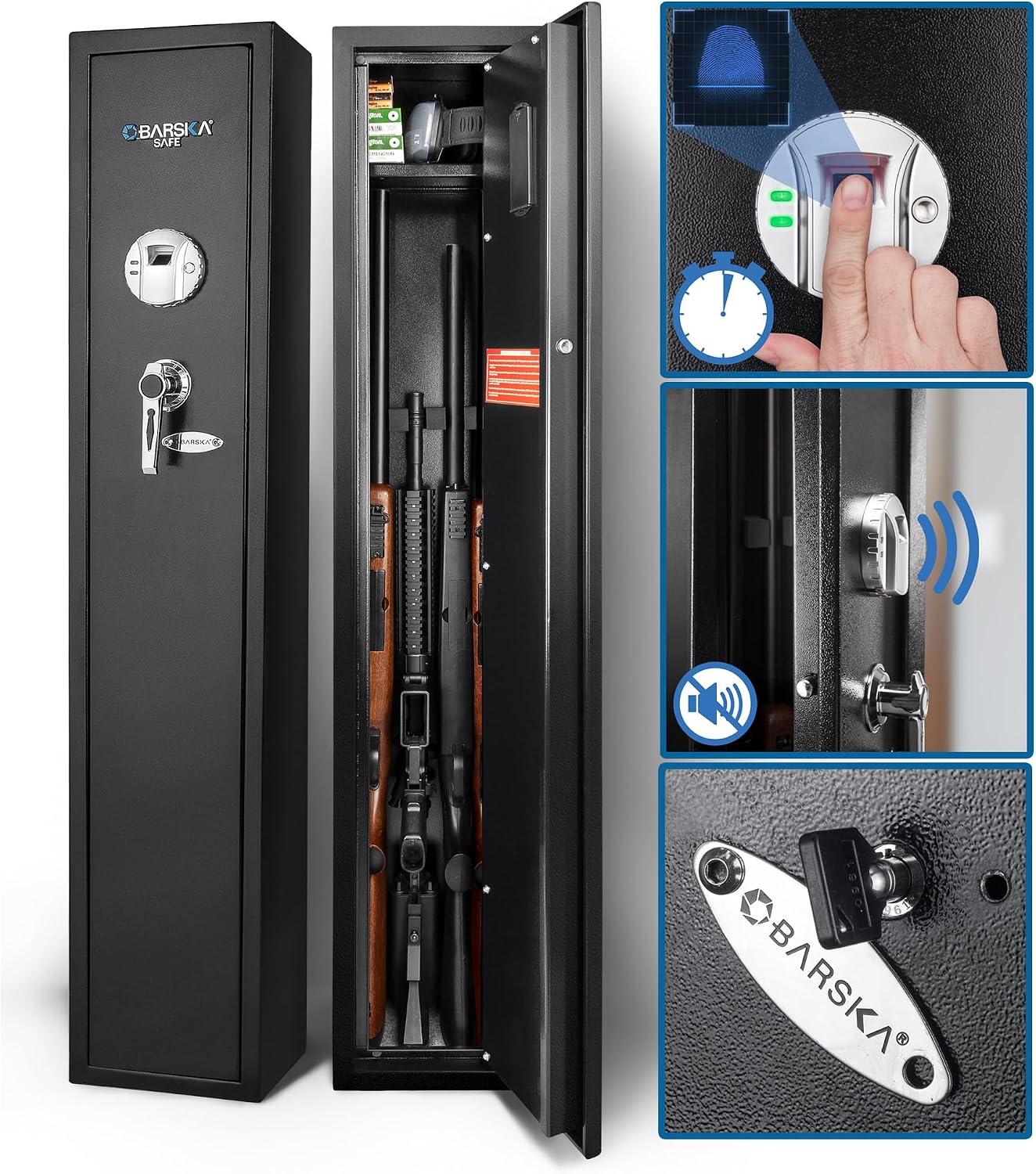
1. Best Overall: Barska Quick Access Biometric Safe
What makes it stand out:
- Access in approximately 2.5 seconds via biometric fingerprint—rare in this price range
- Includes backup battery, ensuring access even during power outage
- 14 gauge steel body (thicker than most budget competitors)
- Multiple mount points for floor and rear anchoring
- Shelf above rifles for handgun and ammo storage
- Multi-point locking system
- Long-term reliability: one of our testers has used one daily for 3+ years with zero sensor issues
What to watch:
- Lightweight construction means bolting down is essential
- Realistic capacity is 2-3 rifles with scopes, not the advertised 4
- No fire protection or fire rating
- Backup key access is clunky in emergencies (biometric is the real feature)
In addition to its impressive safety features, the Barska Quick Access safe’s primary entry mechanism is a biometric fingerprint scanner which gives you access to your firearms in about 2.5 seconds, which is hard to find in gun safes under $500.
Its convenient size makes it easy to store in a closet or other out-of-the-way location. This means your firearms are both stored safely and easy to get at when time is of the essence.
Who should buy it: Gun owners who prioritize quick access and biometric convenience, especially for bedside or home-defense storage. Great for people who want electronic entry without the battery-failure concerns of keypad-only models.
Specifications:
- Price: $336
- Capacity: 4 long guns
- Entry: Biometric sensor
- Material: 14 gauge steel
Dimensions:
- Depth: 8.6″
- Width: 9.5″
- Height: 52″ inches
- Weight: 62 pounds
Nice features like a backup battery
It was also one of the only long gun safes we tested that comes with a backup battery – to ensure access even in the event of a power outage, which is critical with a biometric gun safe. Of course you get a backup key – but no one wants to search around for a key when time is of the essence.
Plus, its 14-gauge steel body and multiple mount points (floor and rear) mean that it can stand up to abuse and remain secure over the long term. The shelf above the rifles accommodates handguns, ammo, and other items that make sense to be stored together.
Stands up to long-term use
One of our experts has had this safe for more than 3 years – he uses it every morning and evening – and reports zero issues with the sensor reading and responding appropriately.
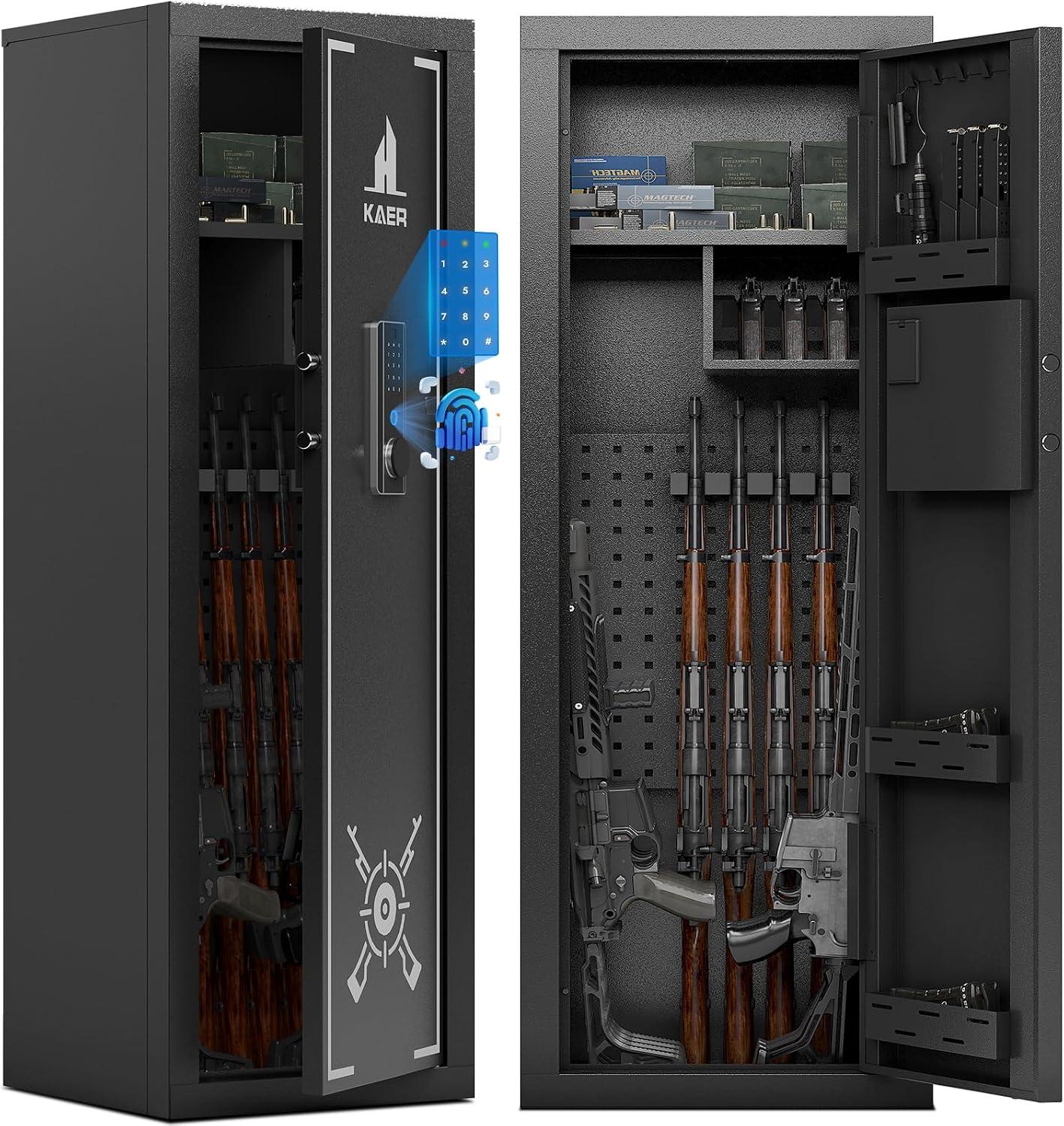
2. Best Large Gun Safe: KAER Biometric Gun Safe Rifle
What makes it stand out:
- Surprising storage capacity for the price—easily stores more firearms than smaller safes
- Solidly heavy at 86+ pounds; looks intimidating (good for theft deterrence)
- Keyed lock is proven, reliable, and kid-safe
- Includes floor and wall mounting holes
- Excellent value per cubic foot of storage
What to watch:
- 16-gauge steel is thinner than premium options
- No fire rating and no fire protection (house fires can damage contents)
- Classified as a cabinet, not a safe (won’t resist determined prying)
- Physical key can be lost or forgotten
- More of a “keep kids and casual thieves out” than a serious safe
Who should buy: Gun owners with large collections (10+ firearms) who need maximum storage space on a tight budget and don’t need quick access. Good for closet storage where kids or guests might browse.
The KAER Biometric Gun Safe Rifle offers much more storage capacity. This safe does not offer a biometric scanner or keypad – so it’s not a quick-access kind of cabinet or going to be very fire-resistant.
Specifications:
- Price: $179
- Capacity: 15 long guns
- Entry: Physical key, keypad & biometric
- Material: 15-gauge steel
Dimensions:
- Length: 15.8″
- Width: 18.5″
- Height: 57″
- Weight: 86 pounds
This is designed to store your firearms, ammo, handguns – and whatever else you want given its footprint – safely at well under the $500 mark. The keyed lock system functions as reliably as any standard lock and key, and given the price point, you get a lot of room for not much investment.
Heavy & secure
At 80+ pounds probably more than anyone would want to try to shoulder out of your home – and it looks intimidating – which should help to discourage would-be thieves.
Of course, bolting it down would make it immobile – and it comes with both mounts and hardware to do so.
This Stack-On is one of the better ways to get a lot of capacity in a budget long gun safe.
3. Best Small Gun Cabinet: ANXINWEI Gun Cabinet
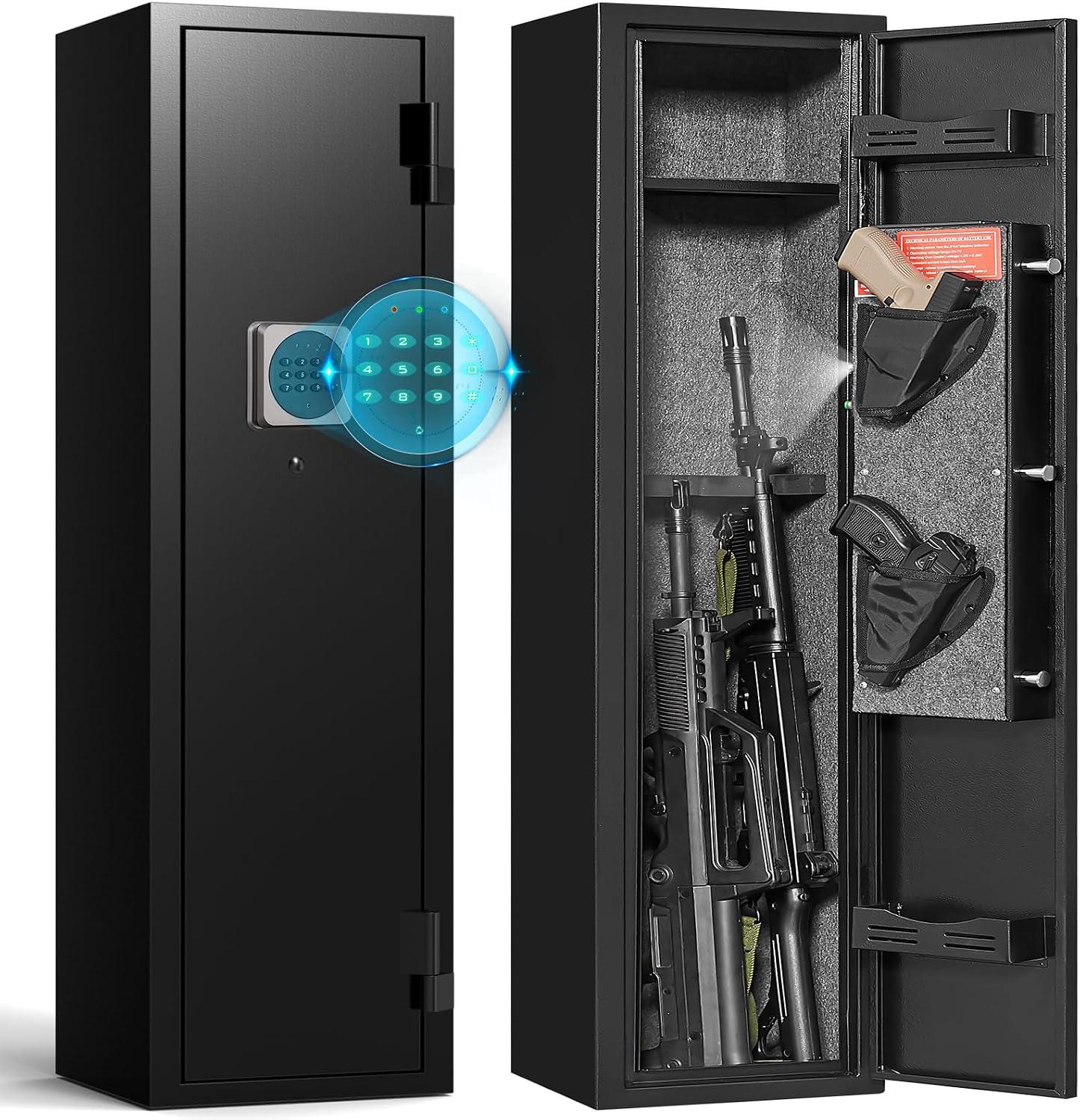
What makes it stand out:
- Most affordable option on our list
- Compact footprint fits smaller spaces (closets, bedrooms)
- Sturdy construction with solid door hinges
- Includes overhead shelf for handguns and limited ammo
- Foam barrel rests protect gun finishes
- Wall and floor mountable
- Lightweight enough to move (though bolting down is recommended)
What to watch:
- Thinner 16 gauge steel (easier to pry than heavier gauges)
- Classified as a locker/cabinet, not a true safe
- Keyed entry only—can’t be quickly accessed
- Light enough that an determined thief could potentially move it
- No fire rating; contents not protected from house fires
- Realistic capacity is closer to 5 with optics, not 10
The ANXINWEI Gun Cabinet is a good, affordable alternative to either of the above options if you are willing to give up both quick-access/biometric options and storage capacity. There’s no keypad – just the physical key – but it still offers decent storage for a limited long gun collection.
The lack of quick-access makes it a poor choice for anyone who needs that feature, but it’s an otherwise capable cabinet—especially if you need to store smaller rifles like a 22LR or a pistol-grip shotgun. Otherwise, the Stack-On GCB-910 is sturdily built, has solid mounting options, and includes an overhead shelf that accommodates a handgun, a limited amount of ammo, and maybe a few accessories.
Who should buy: Budget-conscious gun owners with a small collection (5-7 firearms) who need basic child protection and storage. Ideal for closet mounting or spaces where fire protection is not a concern.
Specifications:
- Price: $179
- Capacity: 3 long guns
- Entry: Physical Key, keypad, and biometric
- Material: 16-gauge steel
Dimensions:
- Depth: 8.6″
- Width: 9.8″
- Height: 52″
- Weight: 61 pounds
Lighter & less robust, but inexpensive
The steel isn’t as thick as some other options, but it does have good door hinges and (somewhat inexpensive) foam barrel rests on the interior. This locker – don’t call it a safe – is a lightweight storage option that will house 10 long guns (probably 5 with optics) and keep them safely away from children, but it’s not a safe in the way most people would expect.
This is the smaller cousin to the above 22-gun Stack-On cabinet and is very similar with the exception of storage capacity. Given that it’s light – around 60 pounds – bolting it down is definitely the way to go.
All in all, if you want to ensure your firearms are well away from guests and children but either don’t want or can’t invest in a proper safe, this cabinet will do the trick.
4. Best Keypad Option: Gearmart Fast Access Safe
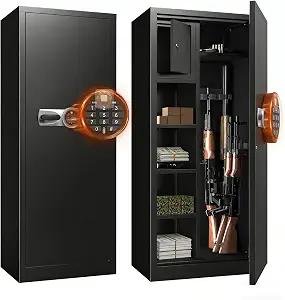
What makes it stand out:
- Keypad entry faster than key, but simpler than biometric
- Multiple entry methods (keypad or physical key)
- Battery indicator on keypad (know when to replace before lockout)
- 4 large locking bolts (~1 inch diameter) for pry resistance
- Internal lockbox for documents, valuables, or small items
- Memory feature keeps code in memory if battery dies (convenience touch)
- Responsive manufacturer—packaging issues corrected, customer feedback taken seriously
- Heavy at 86 pounds (good theft deterrent)
What to watch:
- Door construction better than body construction (slight weak point)
- 16 gauge steel is mid-range
- Keypad batteries require monitoring
- No fire rating
- Will require a code to access even though it’s electronic (not quick-access like biometric
Who should buy: Gun owners who want faster access than a key but prefer keypad over biometric. Good for home-defense scenarios where you need reasonable speed and reliability.
The Gearmart 5-Gun Electronic Rifle Safe is a fantastic safe for people interested in more than a physical key entry mechanism but not looking for a biometric option.
This was one of the few affordable long gun safes that met all of our criteria: a mountable gun safe with decent build quality under $500 that also offered an electronic keypad entry mechanism. It’s a solid cabinet that’s hard to defeat by force and the electronic keypad gives one access to their firearms much more quickly than a key – not to mention you can’t misplace the keypad.
Specifications:
- Price: $
- Capacity: 5 long guns
- Entry: Keypad & Physical Key
- Material: 16 gauge steel
Dimensions:
- Depth: 12″
- Width: 14″
- Height: 57″
- Weight: 86 pounds
Offers a battery indicator & 4 door lock bolts
It also offers nice features like a battery indicator on the keypad – so you’ll know when it’s time to change the battery before it’s too late, as well as an internal lockbox, which provides additional security for things like personal documents or valuables (assuming you have no other option for storing these kinds of things – we recommend a safety deposit box of fireproof box for these.)
The door has 4 lock bolts that are almost an inch in diameter, so it’s a sturdy and secure option in the sub-$500 range
In addition, the keypad has a memory feature which prevents you from having to re-enter your code if the safe’s batteries die which is more of a convenience than anything but still a nice touch.
Beyond the safe’s features, the company behind the product is very responsive – they have responded to customer concerns about flimsy packaging causing damaged product shipments and since that change, the feedback about damaged shipments has all but evaporated.
5. Biometric Budget Pick: Quicktech Large Gun Cabinet
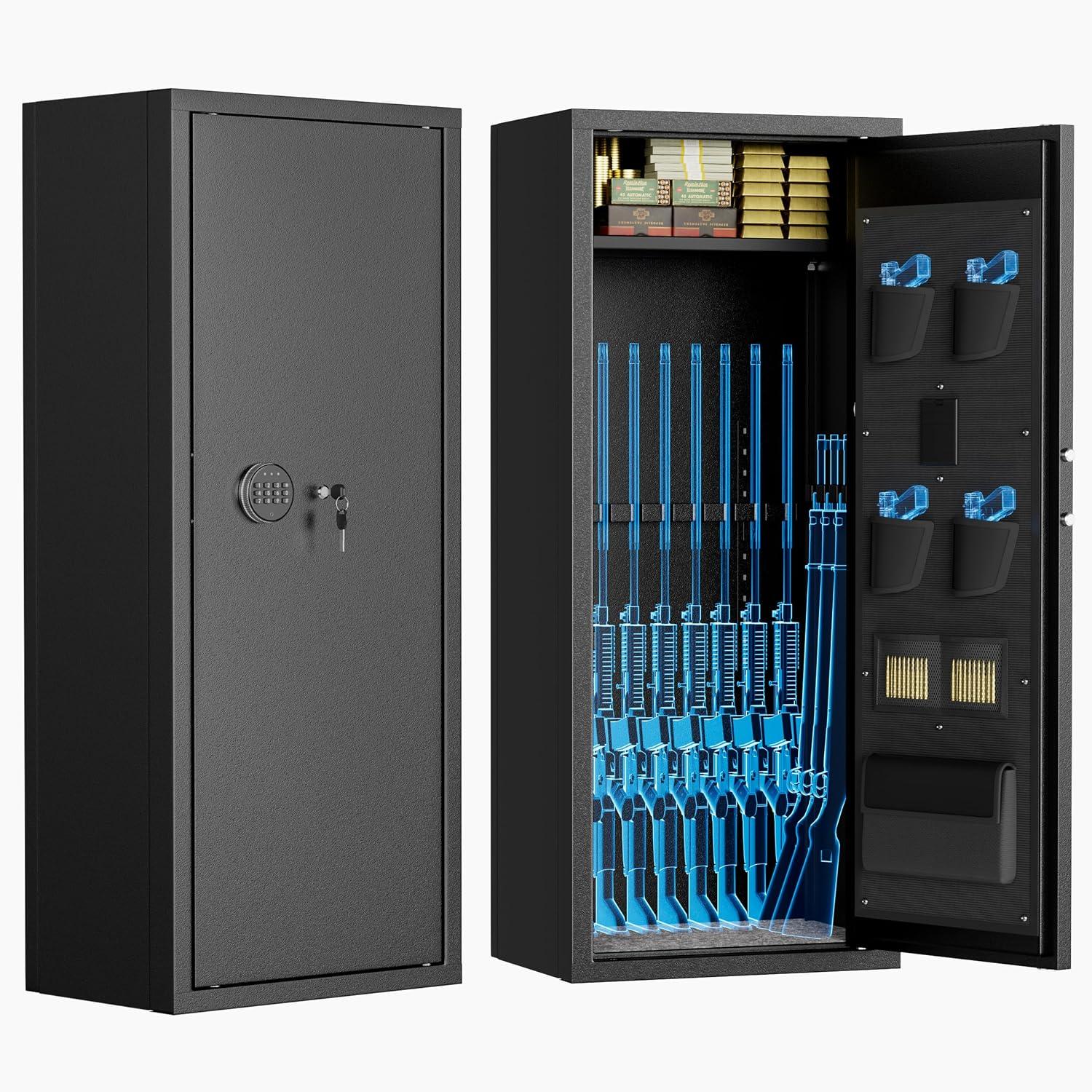
What makes it stand out:
- Three entry methods (biometric, keypad, key) provide flexibility if one fails
- Heavier than some competitors (89 lbs) despite smaller capacity
- 5 door locking bolts (more than the 4-bolt Gearmart)
- Carpeted interior protects rifle finishes
- More generous internal space than specs suggest (testers fit 4-5 rifles easier than expected)
- Dual keypad sound modes, including silent mode (discreet access)
- Biometric feature reliable during testing
What to watch:
- Single-walled steel (less robust than multi-layer or 14 gauge)
- Slightly higher price than Stack-On for similar capacity
- No fire rating
- Weight and internal capacity don’t match expectations (heavier than expected, space-efficient)
Who should buy: Gun owners who want biometric convenience but also need keypad and key backup. Good for those with reliability concerns about single-entry-method safes.
If a biometric entry mechanism is a must-have for your gun safe (but so is staying under $500) we recommend the QuickTec Biometric Quick Access 5-Gun Safe.
This safe doesn’t offer the same steel gauge as the Barska, but it does provide more internal storage space and more weight at 89 lbs. It also has an internal lockbox, which makes it a great option for those interested in smaller storage capacity with biometric entry.
Specifications:
- Price: $$
- Capacity: 5 long guns
- Entry: Bio, Keypad & Physical Key
- Material: Single-Walled Steel
Dimensions:
- Depth: 14″
- Width: 14″
- Height: 57″
- Weight: 89 pounds
5 door lock bolts & more internal space
The door features 5 locking bolts, which is more than other safes in this class and closes securely.
The interior has rifle mounts to help keep your rifles organized and is covered in carpeting to prevent scratches and dents. Our testers were surprised with the weight of the unit – as well as the internal size – which made it easier to get 4-5 guns in it than some of the smaller options.
The QuickTec safe performed admirably in our tests: the biometric feature opened consistently as did the keypad and locks. We also appreciate the dual keypad sound modes – one of which is mute – which prevents alerting others that you’re entering the safe.
While many safes in this class are more cabinets than true safes, the features QuickTec offers make it a compelling product in the sub-$500 market.
Access Methods: RFID vs. Biometric vs. Keypad
Before you pick a safe, you need to pick your access method—because that choice shapes every decision that follows. All the safes on this list do the same basic job: they keep your firearm locked away from people who shouldn’t have it. But how you get to your firearm when you need it matters more than you might think. Speed matters. Reliability matters. Whether you’re fumbling in the dark at 3 AM or punching a code while your hands are shaking makes a real difference in a home defense scenario.
There are three main access technologies competing for your money in the budget safe market, and none of them is a universal win. Each trades something to gain speed, or trades speed to gain reliability. Knowing which trade-off fits your life is half the battle.
RFID (Radio-Frequency Identification) Access
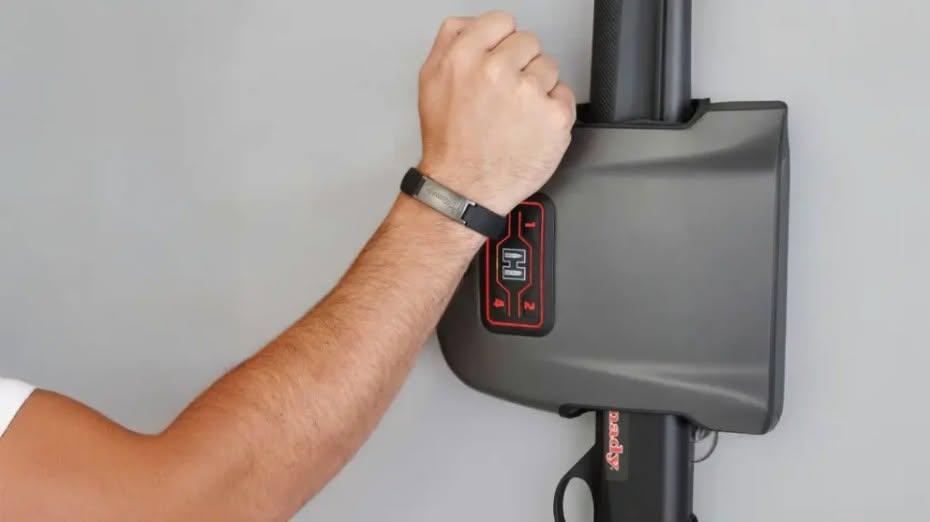
RFID is the fastest way to open a gun safe, period. You’re waving a bracelet or key fob within a few inches of a reader, and the safe is open in under a second—often closer to 0.7 seconds if you’ve got it positioned right. No scanning your finger. No punching in a code. Just wave and grab. I’ve timed all three access methods in real conditions, and RFID wins on speed every single time.
The catch is that you’re carrying a tag, which means it has to be within reach when you need it. A nightstand bracelet works great if you’re sleeping—you’ve got it in arm’s reach. A key fob on your keychain works fine if home defense is your concern and your keys are within a few feet of where you’d need the gun.
But if you lose the fob or misplace the bracelet, you’ve got a keypad or backup key (both safes with RFID also include one or both). Hornady has built its reputation on RFID technology, and the AR Gunlocker and Night Guard are the gold standard for this category—they’re purpose-built around RFID speed and include multiple backup access methods.
Biometric (Fingerprint) Access
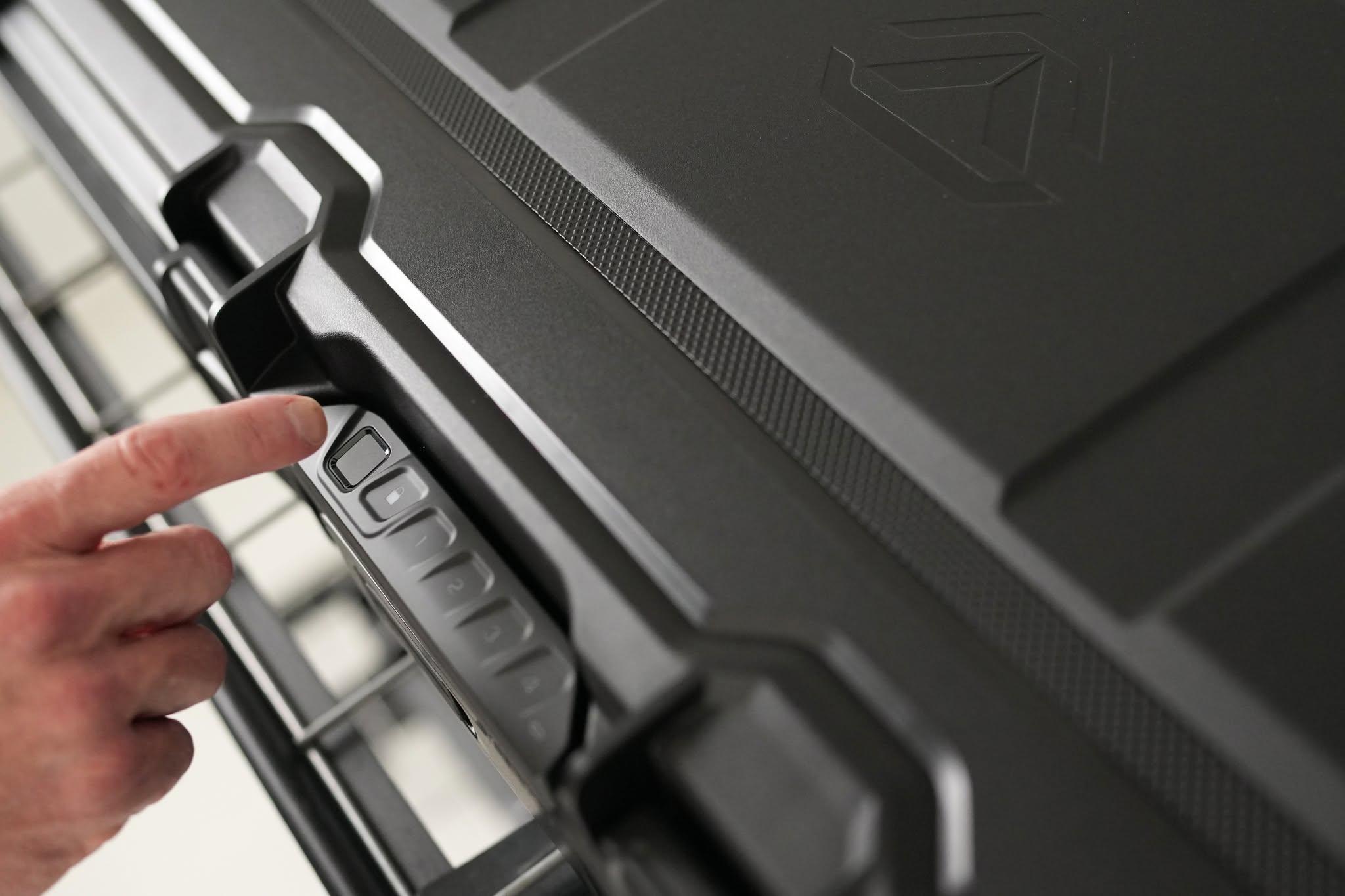
Biometric is nearly as fast as RFID, sitting around 2–2.5 seconds from fingerprint to open door, and the big advantage is that your fingerprint is always with you. No bracelet. No key. Just your finger. That sounds better than it is in practice, though, because fingerprint readers don’t like wet, sweaty, or dirty hands—which is exactly what you might have after firing, or after a full day of work. Modern biometric safes (especially Vaultek’s scanners) have gotten much better at handling marginal fingerprints, but they’re not bulletproof.
The other upside is that biometric systems let you store multiple fingerprints—often 20 or more—so your spouse, adult kids, or a trusted family member can get to the safe without knowing your code or having a separate key. Vaultek’s biometric safes also integrate smartphone apps, which means you can check access history and tamper alerts remotely. If you want to know whether someone tried to open your safe while you were at work, that’s worth something.
The downside is cost. Biometric safes typically run $200–$450 depending on size and steel gauge, which is more than keypad options.
Keypad (Electronic Code) Access
Keypads are the tortoise in this race. They’re slower—typically 3–5 seconds from punch to open—but they’re also the most reliable. No fingerprint quirks. No lost bracelet. No batteries dying on your biometric reader (though most modern safes have multiple backup power options). You punch a four- to eight-digit code and the safe opens. Every time.
The kicker with keypads is that they’re the cheapest access method when you strip out all the other factors. The downside is that there’s nothing special about them. They’re not fast. They’re not novel. They’re just dead reliable, which is why Stack-On and GunVault have built their entire reputation on keypad-based safes at rock-bottom prices.
Which One Should You Buy?
For home defense (bedside gun, nightstand storage), RFID speed wins. You want your firearm accessible in under a second, and the bracelet-on-the-nightstand model is genuinely faster than any other option. Hornady’s the brand to beat here.
For general storage and family safety (keeping guns locked away from kids, secured from casual burglars), any of the three works. You’re not in a rush, so speed is secondary to reliability and cost. A keypad safe is the play here, or a biometric if budget allows and you want the app monitoring.
For vehicle or portable use, biometric with a backup keypad (Vaultek’s approach) gives you redundancy if the fingerprint reader gets wet or dirty during the drive.
Pick your access method first. The safe follows.
What about fireproof safes?
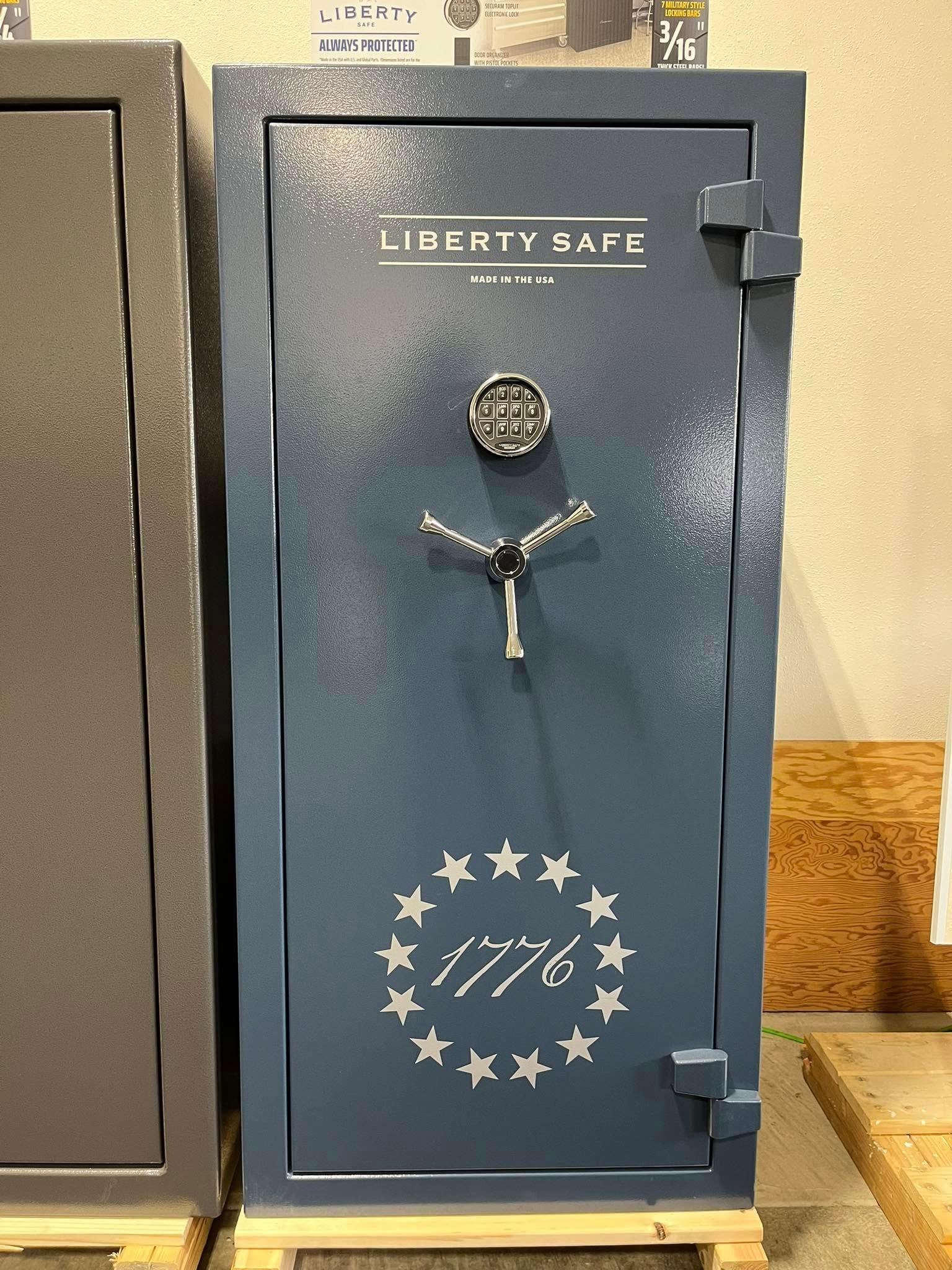
Most of the safes on this list protect your firearms from theft. They’re built to resist pry bars, weigh enough that you can’t just grab and go, and have locks that keep unauthorized hands out. What they won’t do is survive a house fire. The steel will heat up, and anything inside will roast.
If that bothers you—and it should—you need a fireproof safe. And here’s the good news: you can get genuine fire protection under $500. It won’t be absolute, and it won’t hold 24 rifles, but it will protect your handguns and your important documents in a real fire scenario.
What “Fireproof” Actually Means
Fire ratings are measured in two ways: time and temperature. A safe rated for “30 minutes at 1,400 degrees Fahrenheit” means that in a standardized test, the interior temperature of the safe stays below a certain threshold (typically 350°F, which is hot enough to damage some materials but not hot enough to detonate ammunition or destroy documents) while the exterior is exposed to 1,400°F flames for half an hour. That’s not a casual test—it’s a real fire scenario.
Most budget safes aren’t fire-tested at all. They’re theft-rated. You’ll see safes advertised as “fire-resistant” or “fire-safe,” which often just means they’ve got a little more insulation than usual. Ignore those claims. Look for actual fire ratings in minutes and temperature. Real fire ratings cost money because they require thicker walls, insulation layers, and gasketing systems that seal out heat.
The Waterproof Angle
Here’s something people miss about house fires: the fire department’s hoses can do as much damage as the flames. A 2,000-PSI stream of water will destroy documents, corrode metal, and flood anything stored in a standard safe. A fireproof safe worth its rating includes waterproofing—a gasket system that keeps water out while you’re pulling the safe out of the rubble.
The Hornady Fireproof Safe includes a waterproof seal. That matters if you’re storing insurance documents, mortgage papers, passport copies, or anything else you’d need to rebuild your life after a fire. Your handgun survives the heat. Your documents survive the water. Your ammunition might get corroded, but that’s replaceable.
What $500 Gets You in Fire Protection
At the sub-$500 price point, you’re looking at 30-minute fire ratings—which is genuinely useful. A typical house fire reaches flashover (the point where everything in a room ignites at once) in about 5–10 minutes. A well-built structure with firefighters arriving within 15 minutes means your contents are getting hot, but they’re not getting exposed to peak temperature for a sustained period. A 30-minute rating gives you a real safety margin.
What you’re not getting is a 60-minute or 90-minute rating, which starts pushing above $500. You’re also not getting a full-size safe that holds 16 rifles and fire-rated protection—that’s a $1,200+ purchase. What you are getting is a compact, wall-mountable unit that holds two handguns, protects documents, and will keep the interior temperature manageable through a real house fire.
The Hornady Fireproof Safe (Model 95407)
The Hornady 95407 is the only genuinely fire-rated safe in the under-$500 bracket that’s worth buying. It’s 30-minute fire-rated at 1,400°F, has a waterproof seal, and weighs about 30 pounds (heavy enough that you won’t grab it, light enough that you can move it with help). The interior is divided—handguns on one side, documents or valuables on the other. It ships with two AA batteries for the electronic keypad (plus a backup mechanical key). The price runs $210–$220 depending on the retailer.
Is it pretty? No. Is it spacious? No. Does it do one job exceptionally well? Yes. You store your valuable handguns and your important paperwork in here, you bolt it to something stationary (it comes with mounting hardware), and you know that in a fire scenario, the contents will survive.
One note: this safe is not a quick-access safe. There’s no biometric option, no RFID tag. You’re punching a code or using a key, which means it’s designed for storage, not for the gun you need at 3 AM. Pair this with a bedside RFID or biometric safe if you need both rapid access and fire protection—keep your home-defense gun in the Hornady Night Guard or Vaultek on your nightstand, and keep your spare handguns and documents in the fireproof safe in your closet or safe room.
Real-World Use Cases
Fireproof safes make sense if you’ve got valuables that aren’t replaced by insurance claims. Important documents (insurance policies, deeds, mortgage papers, birth certificates, passport copies). Irreplaceable photos or hard drives. Heirloom jewelry. Firearms you inherited and want to protect beyond just theft—the sentimental value matters more than the cash value. And yes, your handguns, especially ones with custom work or personal significance.
Think of it this way: your homeowner’s insurance will replace most of what burns. It won’t replace photographs from your childhood, or your grandfather’s old revolver, or the original deed to your house. Those live in a fireproof safe.
Most gun owners who think seriously about disaster planning end up with two safes: a quick-access safe for home defense, and a fireproof safe for everything else. The good news is that the Hornady Fireproof 95407 costs less than most biometric pistol safes, so adding fire protection doesn’t blow the budget.
Who should consider these recommendations?
This article is built for people with a specific problem: you need to lock up your firearms, you’ve got a $500 budget, and you’re not willing to compromise on security or access speed. But “need to lock up your firearms” covers a lot of ground, and which safe you pick depends heavily on why you’re buying.
If you’re a first-time gun buyer dealing with legal requirements, this is for you. You’ve just purchased your first rifle or handgun, and depending on where you live—especially if you’re in California or another state with mandatory storage laws—you now have a legal obligation to store it safely. You don’t need a $2,000 vault. You need something that locks, meets the DOJ definition of a secure container, and doesn’t break the bank.
Every safe on this list qualifies. Pick based on your access-speed preference: if you want fast entry for home defense, go RFID or biometric. If cost is your primary concern, go keypad. If fire protection matters, the Hornady Fireproof Safe at $210 solves two problems at once.
If you’re a parent or grandparent with kids in the house, this is absolutely for you. Gun cabinets and safes aren’t really optional if you’ve got children around—the statistics on accidental child access are sobering. But as with all things parenting, you have to budget appropriately, and you might not be able to afford a $1,500 safe. The good news is that you probably don’t need to. If your only goal is to keep children, teenagers, and curious visitors out of your firearms, a simple sub-$500 cabinet or safe is all you need.
You don’t need quick entry because this isn’t your home-defense gun—it’s your collection gun, your hunting rifle, your spare pistol. The Stack-On keypad cabinets (the 10-gun or 22-gun models) are purpose-built for this use case: they’re cheap, they lock reliably, and they keep small hands and unauthorized access out. Bolt one to your closet wall and you’ve solved the problem for under $200.
You’re not getting premium steel or a biometric reader, but you are getting legal compliance, peace of mind, and a barrier that stops a curious eight-year-old or a teenage house guest from accessing your firearms.
If you’re focused on home defense, this is also for you—but with a different priority. You need fast access to your bedside gun at 3 AM, and speed matters more than capacity. This is where RFID and biometric safes shine.
The Hornady RAPiD Safe Night Guard ($175–$240) is designed exactly for this scenario: it looks like a bedside alarm clock, it opens in under a second with an RFID bracelet, and it solves the problem of keeping a loaded home-defense firearm accessible to you but locked up from everyone else in the house. If you want something that doesn’t look like a gun safe at all, the Night Guard is your answer.
If you prefer biometric and don’t mind a slightly larger footprint, the Vaultek or Barska biometric options give you fingerprint access, app monitoring on some models, and the ability to store multiple fingerprints (your spouse, an adult child) without sharing your access code. The trade-off is speed—biometric adds a second or two compared to RFID—but for most people, the added security of a fingerprint reader (nothing to lose or misplace) outweighs that small time cost.
If you’re a collector or multi-gun household, you need more capacity than a bedside safe. You’ve got three rifles, two shotguns, a couple of handguns, and ammo scattered across your house. You need a consolidation point—one safe that holds most of your collection and keeps everything organized. This is where the larger cabinets come in. The Stack-On 22-gun cabinet ($317) holds more guns than anything else on this list at this price point. Yes, you’ll actually fit closer to 14–16 with optics, but that’s still a real consolidation point. The Gearmart 5-gun keypad rifle safe ($329) is the sweet spot if you want something smaller and more purpose-built for rifles (wider rack spacing for scopes). The trade-off is simple: more capacity means heavier, means less portable, means you’re definitely bolting it down and not moving it again. This is fine—it’s supposed to be a permanent installation in your closet or safe room.
If you’re renting or you move frequently, you need portability. A 10-gun cabinet bolted to your closet wall is a great permanent solution until you sign a lease somewhere else and your landlord has a different opinion.
The Hornady Night Guard and Barska biometric pistol safe are light enough (15 and 62 pounds respectively) that you can move them with one trip and minimal effort. They’re small enough to fit in an apartment closet or a bedroom corner. They’re not permanent installations—they’re secure storage that goes with you.
Yes, they hold fewer guns, but they’re designed for the person whose living situation might change, or who needs to move their safe between the bedroom, the office, and the vehicle. If you’re renting or you know you’re moving in the next few years, prioritize portability over capacity.
If you need dual-purpose storage (home defense plus valuables), this is worth thinking about. You want a quick-access gun for your nightstand, but you also have important documents, jewelry, or firearms with sentimental value that need fire protection.
Don’t try to fit both into one safe. Get a quick-access RFID or biometric safe for your bedside ($175–$450 depending on your choice), and add the Hornady Fireproof Safe ($210–$220) somewhere else in your home (closet, office, safe room) for documents and spare firearms. Together, they cost $385–$670 depending on what you choose, and you’ve covered both scenarios. Your home-defense gun is accessible in under a second. Your irreplaceable documents and spare firearms are protected against fire and theft.
This is actually the most honest two-safe setup for someone with a $500 total budget: one for speed, one for protection.
If you’re buying a safe for someone else—a gift, or a situation where you’re setting up a household safe—think about the person, not just the specs. Are they tech-savvy and want an app-enabled biometric safe with Bluetooth?
Are they the kind of person who loses key fobs regularly and would be better off with a fingerprint reader or a numeric code? Are they a parent worried about accidents, or a home-defense person worried about speed? Are they someone who’s going to actually bolt the safe down, or are they going to leave it sitting on a shelf? The safe isn’t the problem—the fit between the safe and the person is.
A beautiful Vaultek biometric safe is a waste if the person buying it prefers the simplicity of a keypad, or if they’re going to skip the installation and just put it in a closet.
The bottom line: if you fit into any of these categories, you’re the audience for this page. Pick the category that matches your actual life, not your aspirational life, and the safe choice follows naturally.
What actually matters when picking a safe
Picking a gun safe under $500 means making trade-offs. You can’t have everything: a 24-gun, fireproof, biometric, under-$500 safe doesn’t exist. So before you shop, understand what actually matters for your situation and what’s marketing noise. Here’s how to think through the real decisions.
Steel Gauge and What It Actually Means
You’ll see safes advertised with “14-gauge steel” or “16-gauge steel” or sometimes just “heavy-duty steel.” Lower numbers mean thicker steel (14-gauge is thicker than 16-gauge). What does that mean in real terms?
14-gauge steel is noticeably harder to pry open with a crowbar or screwdriver. It resists impact better. It feels more substantial and looks more professional. You’ll pay for it—safes with 14-gauge construction run $50–$150 more than comparable 16-gauge models.
16-gauge steel is the budget standard. It will stop a teenager with a screwdriver. It will slow down a casual burglar with basic hand tools. A determined person with an angle grinder, a pry bar, and ten minutes can defeat it. But here’s the reality: most residential burglaries are smash-and-grab situations. They last under ten minutes. A 16-gauge steel cabinet that takes five minutes to breach is secure enough for 95% of threat scenarios.
The exception is if you’re storing firearms that are worth stealing—high-end AR builds, valuable vintage rifles, collector handguns. In that case, upgrade to 14-gauge if you can fit it in the budget, or consider bolting your safe to something immobile as a deterrent. An anchored safe is exponentially harder to steal than an unanchored one, regardless of gauge.
Weight, Portability, and the Security-Convenience Trade-off
Lighter safes are easier to move during installation. The Hornady Night Guard (15 pounds) fits in a car. The Vaultek biometric pistol safes (25–35 pounds) are one-person carries. The Stack-On 22-gun cabinet (86 pounds) requires two people and a dolly.
But lighter also means more portable for a thief. A 15-pound safe can be grabbed and carried out. An 86-pound safe can also be grabbed and carried out, but you need help and time, which means more likely to be interrupted. If you’re prioritizing portability (renting, moving frequently), accept that you need to anchor the safe with a cable to something heavier. If you’re prioritizing security, accept that weight means permanence—you’re bolting it down and not moving it again.
There’s no right answer here. Just know what you’re trading. A lightweight RFID safe on your nightstand with a security cable tether is different from a 86-pound cabinet bolted to a closet—one is designed to be moved if you relocate, the other is a permanent installation.
Real Capacity Versus Advertised Capacity
This is where budget safes consistently mislead. A “4-gun safe” from Barska will hold 4 bare AR-15s with no accessories. With optics? Two, maybe 2.5. A “22-gun cabinet” from Stack-On will hold 22 bare rifles standing side-by-side. With scopes and lights? Closer to 14–16. A “5-gun rifle safe” will hold 5 rifles if they’re compact .22s. 5 AR-15s with BCMs and optics? You’re cramming 3–4 in there.
The advertised number assumes your guns are bare minimum. Before you buy, bring your actual firearms or their specifications to the store. Measure them end-to-end. Measure the depth inside the safe. Test-fit a gun with optics if possible. If you can’t physically test-fit, talk to customer service and describe your specific rifles. A good retailer will tell you the realistic number.
Budget yourself for 30–40% fewer guns than the advertised capacity if you run optics or extended controls. Better to buy a slightly larger safe and have room to spare than to max out capacity and have no flexibility.
Fire Rating: What’s Realistic, What’s Not
Any safe that claims “fire-resistant” without a specific time and temperature rating is marketing. Real fire ratings look like “30 minutes at 1,400 degrees Fahrenheit.” That means it’s been tested and certified.
Under $500, you can get a 30-minute fire rating (Hornady Fireproof Safe, $210–$220). You cannot get a 60-minute or 90-minute rating at this price. A 60-minute fire-rated safe typically starts around $700–$800.
Is 30 minutes enough? For most residential fires, yes. Flashover happens in 5–10 minutes. Firefighters typically arrive within 10–15 minutes. A 30-minute rating gives you a margin of safety while your fire department is working the fire. What you’re not protecting against is a fire that burns for hours, which is rare in modern homes with fire suppression systems and faster emergency response.
If fire protection is your priority, a 30-minute fireproof safe is worth it. If it’s a secondary concern, skip the fire rating and invest in security features instead. Don’t split the difference by buying a “fire-resistant” safe that isn’t actually rated—that’s just marketing.
Anchoring: The Non-Negotiable
A gun safe under $500 that isn’t bolted down is just an expensive lockbox that a thief can carry out. This isn’t optional. This is the table stakes of safe ownership.
Every safe on this list comes with bolting hardware or a security cable. Use it. If your closet floor can’t be drilled (rental, concrete, existing damage concerns), use the security cable and anchor it to a bed frame, a closet rod, or a furniture piece that’s heavier than the safe. If you’re mounting to drywall only (no studs), toggle bolts or heavy-duty anchors are acceptable for lighter safes (under 30 pounds). For heavier cabinets, find a stud and bolt directly to it.
Installation takes 30 minutes. Skipping it because installation is inconvenient is the decision that turns a secure safe into a smash-and-grab target. If you’re not willing to anchor the safe, buy something lighter and smaller that you can tether, or reconsider the purchase.
Battery Life and Maintenance
Electronic locks (RFID, biometric, keypad) all require batteries. Hornady’s RFID safes run on 4 AA batteries and typically last 1–2 years of regular use. Vaultek biometric safes use rechargeable batteries that last 3–4 months per charge. GunVault keypad safes use AA or 9V batteries depending on the model.
Here’s what matters: buy replacement batteries when you buy the safe. A dollar’s worth of AAs in a drawer means you’re never locked out. Most safes have a backup mechanical key anyway, but why use it if a fresh battery fixes the problem in 30 seconds?
For biometric safes with rechargeable batteries, treat charging like phone maintenance. Charge it quarterly even if you haven’t used it. Batteries that sit discharged for months lose capacity. Batteries that are charged regularly stay reliable.
Access Speed in Real Scenarios
RFID is fastest (under 1 second) in controlled conditions. In the dark at 3 AM? Still under 2 seconds if you know where the bracelet is. In a panic? About the same—muscle memory takes over.
Biometric is 2–3 seconds under normal conditions. With wet, sweaty, or dirty fingers? 4–6 seconds as it recycles through retries. In a genuine home-defense scenario, those extra seconds might matter.
Keypad is slowest but most reliable (3–5 seconds), assuming you remember your code and don’t punch it wrong in stress. Punch it wrong twice and many safes lock you out for 30–60 seconds as a security measure.
None of this is fast enough to be your primary home-defense weapon access point if there’s a gun fight in progress. Safe access is for securing the firearm you just used, or accessing it in a planned scenario (nightstand, home invasion response). If you’re expecting combat scenarios where seconds matter, you’re not shopping at the $500 level anyway.
The Price-to-Value Trade-offs
Budget safes have price cliffs. At $150–$200, you get basic keypad security in a small format (GunVault MultiVault). At $250–$350, you step into RFID speed (Hornady Night Guard) or compact biometric (Vaultek compact). At $400–$450, you’re buying premium biometric with app features (Vaultek MRi). Jump to $500+ and you can add fire rating or larger capacity.
Where’s the sweet spot? For most people, $300–$350 buys you the best value: RFID or compact biometric with redundant access methods, enough capacity for 1–2 guns plus accessories, and proven brand reliability (Hornady or Vaultek). Under $250, you’re making real compromises on speed or capacity. Over $400, you’re paying for features you might not use (app monitoring, fire rating, premium finishes).
That said, budget matters. If you’ve got $200, a Stack-On keypad cabinet or a GunVault pistol safe is perfectly legitimate. If you’ve got $500, spend to $350–$400 and get better access speed and redundancy, then allocate the remaining $100–$150 to a fireproof safe or bolting hardware.
Common Mistakes to Avoid
Don’t buy a safe based on aesthetics. The fancy gun cabinet with wood paneling isn’t more secure than the utilitarian steel box. It’s just prettier. If looks matter to you, fine—but know you’re paying for styling, not security.
Don’t assume “safe” means fireproof. Most safes are theft-rated, not fire-rated. Read the specs. If fire protection isn’t explicitly mentioned with a time-and-temperature rating, assume it’s not there.
Don’t cheap out on anchoring. A $500 safe that’s bolted to the floor is secure. A $1,000 safe sitting loose on a shelf is just an expensive box waiting to be stolen. Bolt first, features second.
Don’t confuse capacity with usability. A 22-gun cabinet that holds 22 bare rifles might hold 12 of yours with optics, and that 12-slot configuration will be so tight that accessing one gun requires moving three others. Usable capacity is always lower than advertised capacity. Budget for 60% of the advertised number.
Don’t ignore water damage. In a house fire, the fire department’s hoses can destroy paperwork, corrode metal, and flood electronics as much as the flames. If you’re storing documents or valuables alongside firearms, a waterproof seal matters. The Hornady Fireproof Safe includes one. Most other budget safes don’t.
The Decision Framework: What to Prioritize
If home defense is your primary concern: prioritize access speed. RFID or biometric. Budget $300–$400. Bolt it to your nightstand.
If child safety is your primary concern: prioritize reliability and simplicity. Keypad or basic mechanical lock. Budget $150–$250. Bolt it to your closet. Aesthetics don’t matter; function matters.
If you’re storing a collection: prioritize capacity and security. Larger cabinet or safe with heavier gauge steel. Budget $300–$400. Bolt it permanently to a wall or closet.
If you need portability: prioritize weight and cable anchoring. Compact RFID or biometric. Budget $200–$350. Accept lower capacity; plan to move it if you relocate.
If fire protection matters: budget separately for fireproof ($210–$220) and add a quick-access safe on top of that. Plan for $450–$550 total if you want both speed and fire protection.
Pick your priority first. Everything else follows.
California Firearms Storage Laws & SB 53 Compliance
If you live in California, gun storage just became legally mandatory. Senate Bill 53, which took effect January 1, 2023, requires California gun owners to store firearms in a locked container or secure facility when the firearm is not in their immediate possession and control. The law applies whether you’re at home, at work, or anywhere else. The penalties for non-compliance are real: fines up to $1,000 per firearm, plus criminal liability if a stored firearm is accessed by an unauthorized person and used to cause injury.
If you’re in California, this isn’t theoretical. Every safe on this page qualifies as a DOJ-approved locking container under SB 53. That means you can legally store your firearms in any of them and satisfy the storage requirement, assuming you use the safe as intended (locked, with access limited to authorized users).
What Qualifies as a Locking Container?
The California Department of Justice recognizes several categories of compliant storage: a locked safe, a locked container, a locking gun cabinet, or a firearm with an approved locking device installed. The safe doesn’t have to be fireproof. It doesn’t have to be bolted down (though that’s recommended for security reasons unrelated to SB 53). It just has to lock and keep unauthorized people out.
Every safe on this list—the Barska biometric, the Stack-On keypad models, the Hornady RFID safes, the Vaultek biometric units, the GunVault multigun safe, the Gearmart keypad rifle safe—qualifies. None of them are borderline. They all meet the DOJ definition of an approved locking container.
Why This Matters
If you’re moving to California or you’re a California gun owner who’s been storing firearms in a nightstand drawer or a closet safe without a lock, SB 53 just changed your calculus. You don’t have a choice anymore. Storage is mandatory. The good news is that this page gives you legal options under $500.
If you live outside California, SB 53 doesn’t apply to you, but it’s worth knowing that several other states (and local jurisdictions within gun-friendly states) are adopting similar storage requirements. The trend is moving toward mandatory storage laws nationwide, so buying a compliant safe now hedges against future regulation wherever you live.
Verify Current Requirements
California gun laws change frequently, and SB 53 has amendments and updates that stack on top of the original bill. Before purchasing, verify current storage requirements with the California Department of Justice or consult a local firearms attorney if you’re unsure whether your specific situation complies. The information here reflects SB 53 as of August 2026, but the state continues to refine storage regulations.
The bottom line: if you live in California, every safe on this list is legally compliant. Pick the one that fits your use case and your budget, lock it, and you’ve satisfied the legal requirement.
Our Recommendation
For most gun owners on a budget, the Barska Quick Access Biometric Safe. offers the best balance of security, reliability, and speed. The 14 gauge steel is thicker than competitors, the biometric entry is fast and dependable (even after years of heavy use), and the backup battery ensures access during outages.
However, if large capacity matters more than quick access, the Stack-On 22-Gun Cabinet provides surprising value and storage for $317.
If you want electronic access without biometric, the Gearmart 5-Gun Safe with keypad and locking bolts is solid.
All five options prioritize child protection, which is the baseline for responsible gun ownership.
Final Thoughts
A budget gun safe (or cabinet) is not a luxury—it’s a responsibility. Whether you’re protecting firearms from unauthorized access, keeping guns away from children, or securing valuables, gun storage matters.
Understand that budget safes under $500 do not offer fire protection or serious burglary resistance. They are designed to keep honest people honest and children safe. If you need true fire or burglary protection, budget for a higher-tier safe.
Choose based on your primary need (quick access, large capacity, compact footprint, child protection), verify your state’s storage requirements, and bolt your safe down. Your firearms—and your peace of mind—depend on it.
More Reading
For additional info check out the NRA family’s take on how to select a gun safe.
FAQs
Do I really need to bolt down a budget gun safe?
Can I store rifles with accessories like scopes in these safes?
What's the difference between a safe and a cabinet?
Do I need fire protection at this price point?
Are RFID bracelets reliable, or should I use biometric instead?
Which brands have the best warranty and customer service?
What happens if the battery dies on my electronic safe?
Can I use my safe in my truck or vehicle?
Are there any state or federal regulations I should know about besides California SB 53?
Meet the Experts

Written By
Michael Crites
Licensed Concealed Carry Holder
- Founder of AmericanFirearms.org
- Licensed Concealed Carry Holder
Gun Safe Reviews
Further Reading

Updated
August 21, 2026 — We’ve significantly expanded this guide to reflect changes in the budget gun safe market and reader feedback. This update includes new sections on RFID vs. biometric vs. keypad access methods, fireproof and fire-resistant options under $500, California SB 53 compliance requirements, and an FAQ addressing the most common questions we’ve received from readers.