Suppressors Are “Deregulated”, So Why Does Buying One Still Depend on Your Zip Code?
The tax stamp was the cheapest part of the suppressor ownership process. That's still true. We clarify what actually changed with the OBBB — and what didn't.

Written By
Michael Crites
Licensed Concealed Carry Holder
Reviewed by
Editorial Team
Learn About The Editorial Team
Share:
Products are selected by our editors. We may earn a commission on purchases from a link. How we select gear.
Updated
Sep 2026
In 1915, a man named Herman Auerbach murdered his wife and children with a firearm fitted with one of Hiram Percy Maxim’s new silencers, and the New York papers ran with it: SILENT GUN KILLS A FAMILY OF FOUR.
Maxim himself rushed to New York to demonstrate that a suppressed gunshot is still very much audible (the full story is worth reading in RECOIL’s history of how fear stamped out silencers) — Hollywood’s library-quiet “pfft” has never been real, not in 1915 and not now — but nobody wanted the correction.
Even Theodore Roosevelt, who owned and liked suppressors, wrote back to Maxim that his sympathies were with him but that he didn’t have the political capital to say so publicly. By 1934, when Congress folded silencers into the National Firearms Act alongside machine guns and sawed-off shotguns, the legislative record shows essentially no debate about noise suppression at all. They went in almost as an afterthought, riding the coattails of Tommy-gun panic and a conservationist crusade against “silent” poaching.
Ninety-two years of a $200 tax stamp, fingerprints, a passport photo, and a months-long wait, and the thing being taxed was never really the problem. The paperwork was the point.
That’s the backdrop worth knowing before you wade into what’s happening right now, because the current moment rhymes with 1934 more than most coverage of it lets on: a legal fiction gets built into federal law, persists for generations because nobody has standing or nerve to challenge it, and then falls apart almost overnight once someone finally does.
San Angelo, August 5
On August 5, 2026, Judge Jensen of the Northern District of Texas (San Angelo Division) ruled in Silencer Shop Foundation v. Bureau of Alcohol, Tobacco, Firearms and Explosives that the NFA’s registration and approval scheme for suppressors, short-barreled rifles, and short-barreled shotguns can no longer stand.
The government’s authority to regulate those items had always rested on the taxing power (Congress can attach conditions to something it taxes), but the One Big Beautiful Bill Act zeroed out the $200 transfer tax on those items back in 2025.
No tax, no taxing-power hook, no constitutional basis for the registration scheme built on top of it. The court gave the government a seven-day stay to run to the Fifth Circuit if it wanted to, then let the judgment take effect.
In practice, that meant qualifying buyers could suddenly walk out with a suppressor on a standard ATF Form 4473, the same form used for a handgun, instead of the old Form 4 process, with its fingerprint cards, passport photos, and three-to-ten-month wait even under the ATF’s newer eForm system.
I’ve filled out enough of those forms over the years to know what a genuine paperwork reduction feels like, and this is that, for the people it actually applies to, which is the catch. It applies to some people, some of the time, in some of the country.
Twenty-Seven States, Not Fifty
Here’s where “suppressors are deregulated” stops being a reasonable position. Of the fifty states, roughly 27 currently allow over-the-counter suppressor purchases under the ruling. Eight states ban suppressor ownership outright regardless of what a Texas district court says about federal law.
And fifteen more states – Alaska, Colorado, Connecticut, Georgia, Michigan, Mississippi, Montana, Nevada, North Carolina, North Dakota, Ohio, Oregon, Pennsylvania, Washington, and Wisconsin among them – still require the old NFA registration process as a matter of state law, ruling or no ruling.
Plus, even in a green-light state, the 4473 pathway currently only runs through the named plaintiffs in the case or their affiliated organizations: Silencer Shop, B&T USA, Palmetto State Armory, SilencerCo, or membership in a group like Gun Owners of America.
Walk into a dealer who isn’t in that chain, and you may just get the old Form 4 process anyway, because your dealer’s lawyer told them to keep doing it that way. A distinction NRA-ILA’s own Q&A on the case has had to spell out for its own members.
And that’s before you get to the dealers themselves, who are the ones actually holding the risk here. NSSF’s Mark Oliva put it about as plainly as an industry spokesman is going to: “This is confusing for everyone.” Silencer Central CEO Brandon Maddox has said much the same thing from the retail side. A lot of dealers, he noted, are simply unwilling to run the 4473 transfer, all over the country, even when a customer’s suppressor has already shipped to their counter.
One range in Idaho, Grand Teton Gun & Range, paused suppressor sales entirely after a local ATF office gave informal guidance, then resumed once ownership talked to other dealers and decided the informal advice didn’t carry the weight of the actual order.
That’s not operating with confidence; it’s a business guessing. The guessing is happening because the people who could end it won’t put their foot down.
As of this writing, the DOJ and ATF have offered no public guidance — not to dealers, not to the public — on how the agency intends to treat the ruling while an appeal window remains open. That window runs sixty days from the judgment, putting the deadline in early October, and industry sources following the case don’t expect Washington to clarify anything before then.
Announcing a position now would tip the government’s hand on its own appeal strategy. So the silence isn’t an oversight; it’s a strategic decision, just one that leaves everyone downstream of it improvising.
Rocks to Throw
When it comes to rocks to throw at the “suppressors are free now” narrative — and AllOutdoor’s rundown for buyers is a good companion read here — there are three worth naming plainly.
First, interstate transport of a suppressor acquired without NFA registration remains illegal under existing federal transport law; so a can bought on a 4473 in Texas doesn’t necessarily travel with you to your hunting lease in Colorado, ruling or not.
Second, every purchase, registered or not, still runs through a Form 4473 and a NICS check, because suppressors remain firearms under the Gun Control Act regardless of what happens to their NFA status. Nothing here removes a background check from the process; it removes a second, redundant one.
Third, and the one that should actually keep a buyer up at night: if the Fifth Circuit or the Supreme Court eventually reverses this ruling, the suppressors purchased in the meantime don’t retroactively become legal just because they were legal on the day of sale. People are buying into a window that could come back to bite them.
None of that stopped anyone this August. NICS data shows NFA-related background checks — Forms 1 and 4 combined — up 202 percent year over year, with Texas, Florida, and Georgia leading the country in volume.
Whatever confusion exists at the dealer counter, it hasn’t slowed demand at all. If anything, the uncertainty seems to be accelerating it, on the theory that a suppressor in hand today beats a clarified legal landscape six months from now.
I don’t think that’s an irrational bet, but I do think it’s a bet nonetheless, and the trade press covering this story as a done deal is doing its readers a disservice by not saying so. A hundred and ten years after a New York newspaper decided a suppressor was more newsworthy than the murderer holding it, the government still hasn’t figured out how to talk about these things clearly — and for the moment, neither has anyone waiting for clarity.
Court documents for the case are available via CourtListener.
In This Article
What the Hearing Protection Act Was Supposed to Do
The bill that passed isn’t the bill that was proposed. For years, the Hearing Protection Act promised to remove suppressors from NFA regulation entirely — not just waive the tax, but deregulate the category so that buying a suppressor worked like buying any other firearm accessory. Walk in, background check, walk out. No registry. No wait. No fingerprints and passport photos submitted to a federal database.
That’s not what happened. The HPA language was stripped from the Big Beautiful Bill during Senate parliamentarian review before passage. What survived was a fee waiver. The NFA registry is intact. The ATF Form 4 is intact. The fingerprints and photograph requirements are intact. The SOT-holding dealer requirement is intact. The transfer process that has historically taken eight to twelve months — and that was compressed to days by ATF’s eForms system by late 2025 — is intact.
The $200 is gone. The rest of the NFA is not.
Where the Tax Was Never the Barrier
The $200 stamp mattered more as a symbol than as a practical barrier, and it’s worth being precise about why.
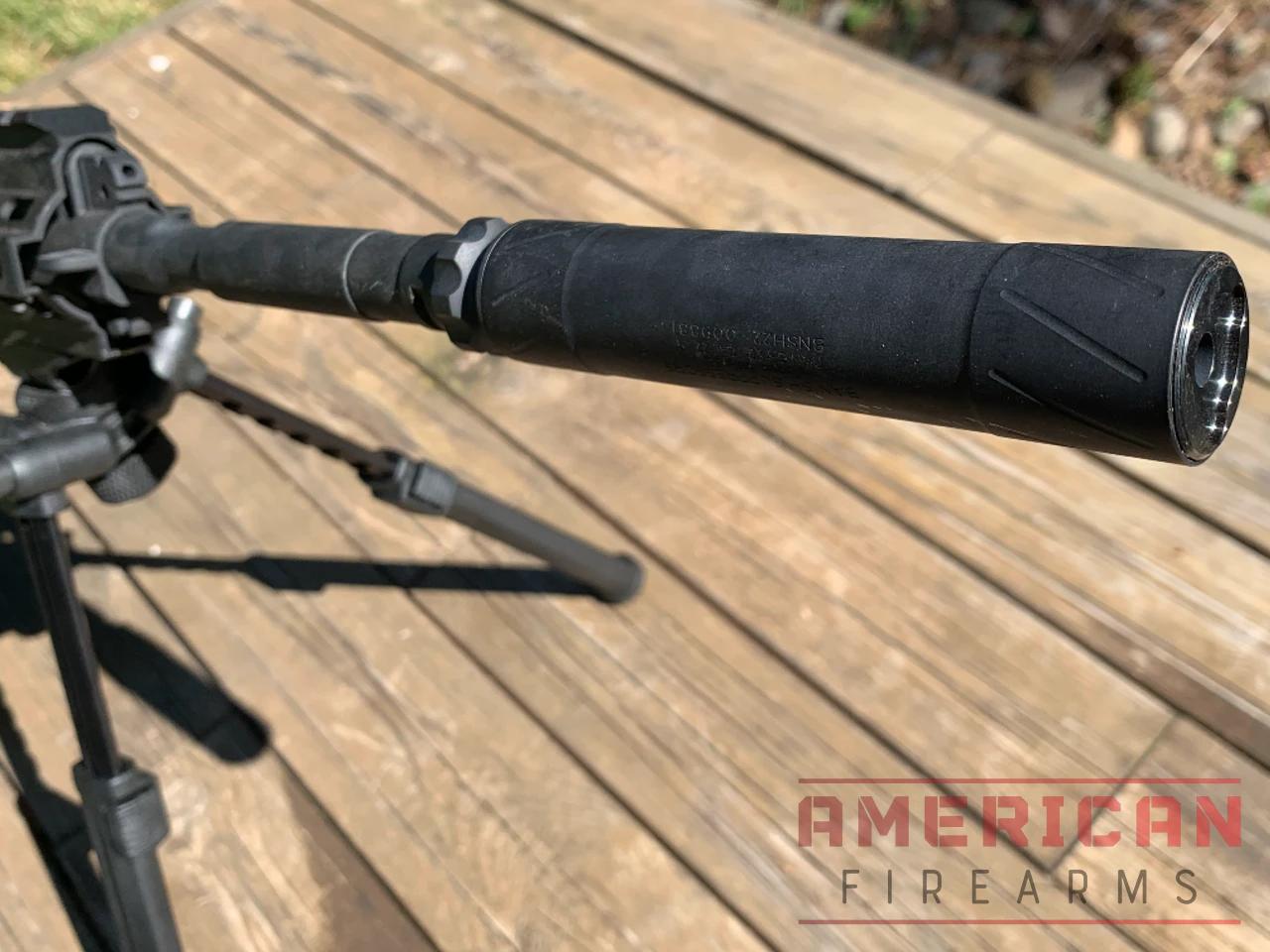
Suppressors are not cheap accessories. Entry-level cans from reputable manufacturers — your Dead Air Mask, your SilencerCo Sparrow — run $350 to $450. Mid-tier rifle suppressors, $600 to $900. Premium options from Gemtech, OSS, or the upper SilencerCo line cross $1,000 without difficulty.
The $200 tax was real money on top of those prices, but for a buyer who can afford a $700 rifle suppressor, the $200 stamp is an annoyance, not a decision point. For a buyer who couldn’t swing the stamp, there’s a reasonable chance they couldn’t swing the suppressor price either.
That math was always the problem with framing the $200 as the primary access barrier. Suppressors are manufactured at meaningful scale — the ATF’s 2023 AFMER data reports 1,305,530 miscellaneous firearms produced that year, a category that includes suppressors as its largest component.
That production exists. But it’s concentrated in a market where the buyer profile is, to a substantial degree, someone who planned ahead, has the budget, and was willing to tolerate a bureaucratic process. The $200 was not screening those buyers out.
What was screening buyers out is the process itself. A new suppressor buyer in 2026 without the $200 stamp still needs to: select a suppressor from an SOT-holding FFL, submit an ATF Form 4 with two sets of fingerprints and a passport photo, wait for ATF approval before taking possession, and remain compliant with the NFA registry for the life of their ownership.
That process is shorter than it was in 2022 — eForms processing in late 2025 was running days rather than months for clean applications — but as of May 2026 the surge of pent-up demand has extended Form 4 processing to almost a week. The ATF’s own guidance anticipated processing delays as buyers who had been waiting for the stamp elimination rushed the queue.
Then there’s the state question, which the federal celebration largely ignored. Suppressors remain prohibited for civilian ownership in California, New York, Illinois, New Jersey, Massachusetts, Hawaii, Delaware, Rhode Island, and several other states. Millions of American gun owners — a substantial share of the total national firearm-owning population — received zero practical benefit from the federal change. Their state law didn’t move.
The Right Way To Think About Can Ownership
The right way to think about suppressor ownership in 2026 is not as a decision unlocked by the tax elimination. It’s as a decision shaped by three independent variables, only one of which changed.
State law is the first filter. If you live in a prohibition state, the federal change is academic. Full stop.
The NFA process is the second filter. The Form 4, the wait, the dealer SOT requirement — these remain. For a buyer who was deterred by the process rather than the price, nothing changed. For a buyer who was deterred by both, half the deterrent is gone.
The total cost of suppressor ownership is the third filter. With the $200 stamp removed, the total acquisition cost on a mid-tier rifle suppressor drops from roughly $900 to $700. That’s a real reduction. For buyers near the margin of affordability, it moves the needle. It doesn’t transform the category.
If you’re in a suppressor-legal state, have absorbed how the Form 4 process works, and have been holding off primarily because of the $200, January 1 was your day. Buy the suppressor. The process is as frictionless as it’s been in ninety years.
If you were waiting for suppressors to become as easy to buy as a rifle scope, that outcome required the Hearing Protection Act’s full passage. It didn’t pass. The Constitutional Hearing Protection Act (H.R. 3228, Rep. Clyde) is in committee as of early 2026, and the three constitutional lawsuits challenging whether NFA registration can persist without the tax may eventually force the issue — but court timelines are not a purchasing strategy.
Three Valid Objections
“The $200 adds up across a collection.” Correct. A buyer adding three suppressors over five years saved $600 under the new regime. That’s real money. The piece isn’t arguing the tax elimination is worthless — it’s arguing it’s not the transformative access expansion the community anticipated. Those are different claims.
“Dropping the barrier at all will bring new buyers into the category who wouldn’t have come otherwise.” Probably true on the margin. But the evidence for $200 as a category-defining barrier is weak when the alternative explanation — that suppressor buyers are deterred by process friction, not stamp cost — fits the available data. If suppressor registrations were 150,000 annually before the change, a doubling to 300,000 would be meaningful. A 20% bump would confirm the marginal buyer thesis but wouldn’t change the mainstream ownership picture.
“You’re moving the goalposts — the elimination was a political win, not just a financial one.” The strongest version of this objection. The $200 tax carried symbolic weight as a punitive relic of 1934 politics. Removing it has political meaning that transcends the dollar amount. Fair point. But political wins and access expansions are different things, and most of the commentary conflated them.
So, What Actually Changed?
The suppressor market is more accessible in 2026 than it was in 2025. The barrier to entry is lower. The buy-in is more defensible for a budget-conscious shooter. Those are real improvements, and the industry that worked for this outcome deserved the July 4 moment it got.
What didn’t change is the architecture. A suppressor is still a registered NFA item. The federal government still maintains a central registry of who owns one and where. The dealer infrastructure requirement still limits where you can make the purchase. The approval process still requires patience the gun counter at your local big-box retailer is not built to accommodate.
Hiram Percy Maxim patented the first commercially successful suppressor in 1909 and sold it through newspaper ads as a tool for neighborly range use. He probably didn’t anticipate that 116 years later, the federal government would eliminate the tax that made his product a bureaucratic exercise — and leave every other piece of the exercise exactly where it was.
The $200 is gone. The wait is not. Plan accordingly.
Sign up for our newsletter
Get discounts from top brands and our latest reviews!
View by Category

In-Hand Reviews

Firearm News

Featured Comparisons

Firearm & Ammo Reviews

Popular Guides & Stats

Range Gear & Accessories


Gun & Ammo Safes