The Caliber Wars Were Always Marketing

Written By
Michael Crites
Licensed Concealed Carry Holder
Reviewed by
Editorial Team
Learn About The Editorial Team
Share:
Products are selected by our editors. We may earn a commission on purchases from a link. How we select gear.
Updated
Apr 2026
April 11, 1986. Pinecrest, Florida. Two bank robbers — William Platt and Michael Matix — are stopped by eight FBI agents in a residential neighborhood, and what follows is four minutes and eighteen seconds that will reshape American handgun culture for the next three decades.
Platt and Matix are killed in the firefight. So are Special Agents Gerald Dove and Benjamin Grogan. Five other agents are wounded, several critically. The exchange of gunfire produces 145 rounds, 12 gunshot wounds on the two suspects, and one finding that will outlast everything else in the official post-shooting analysis: Special Agent Dove fired a .38 Special +P 158-grain semi-jacketed hollow point that struck Platt in the right arm, transited the limb, entered the chest cavity, collapsed the right lung, and nicked the heart.
Penetration into the thoracic cavity: approximately 1.9 inches. Not enough to reach the major blood vessels. A wound that would have been fatal within minutes proved insufficient to stop a man who, despite it, retrieved his rifle and killed two federal agents before finally succumbing.
The FBI characterized this as a penetration failure. They were right. What they did next is where the story gets complicated.
The institutional conclusion was to change the caliber. The FBI’s own Ballistic Research Facility, working in the same building, at roughly the same time, had reached a different conclusion: that caliber was the wrong variable to optimize. Their findings went into a report published in 1989. The .40 S&W went into production in 1990. The ammunition industry spent the next thirty years hoping you’d read the second document and not the first.
The thirty-year debate between 9mm, .45 ACP, and .40 S&W as defensive calibers was sustained by marketing rather than ballistic evidence — evidence the FBI’s own researchers had compiled before the debate formally began.
In This Article
Why It Matters Who Was Right
The caliber debate carries costs that aren’t abstract. A carrier who believes caliber is the primary variable in defensive performance will make decisions on that basis: selecting ammunition by the number stamped on the headstamp rather than by terminal performance, carrying fewer rounds in a larger-caliber gun, absorbing more recoil per shot, paying more per round for practice.
They may end up with a .45 ACP load that fails FBI penetration protocols while a properly selected 9mm load passes. The caliber debate obscured the fact that what matters is the projectile, not the case it sits in.
The institutional costs were larger. Law enforcement agencies across the country cycled from 9mm to .40 S&W beginning in the early 1990s and have spent the last decade cycling back, buying new service pistols on both ends of the transition and retraining on new platforms twice.
The LAPD made the switch. The FBI made the switch, then made the switch back. Thousands of agencies followed the same arc. That is not a small expense, and it was driven by a performance advantage that the FBI’s own ballistic scientists had characterized as marginal since before .40 S&W existed.
For civilian carriers, the practical question is simpler: is the load in your gun right for the job, regardless of what’s printed on the box?
What the FBI's Own Lab Found — Long Before the Debate
The 1989 FBI Ballistic Research Facility report, “Handgun Wounding Factors and Effectiveness,” is the document most people in this debate have never read. It predates the internet, predates the caliber war it should have preempted, and does not make for comfortable reading if you’ve spent money on a .45 to solve a problem the report says doesn’t exist.
The report’s central finding: at handgun velocities, the temporary cavity produced by a projectile — the tissue displacement that expands outward from the permanent wound channel — does not have a meaningful wounding effect. Temporary cavity matters in rifle rounds, where velocities exceed roughly 2,000 feet per second.
In handgun rounds, it does not. “In order to cause significant injuries to a structure,” the report states, “a pistol bullet must strike that structure directly.” Temporary cavity size — the dimension that changes most between 9mm and .45 ACP — is, in the authors’ word, irrelevant to handgun terminal performance.
What determines lethality in a handgun wound is penetration depth and permanent cavity diameter. The FBI established its minimum standard at 12 inches of penetration in bare 10-percent ballistic gelatin, with a preference for 18 inches. The permanent cavity is a function of the projectile’s expanded diameter, which is a property of bullet design, not of caliber.
Two years before this, in September 1987, the FBI had convened a Wound Ballistics Workshop at Quantico specifically to address the 9mm vs. .45 question. The workshop’s conclusion, as cited in the 1989 report: “.45 caliber was better than 9mm in terms of wounding effectiveness, except for the new 147-grain 9mm subsonic round. The subsonic round is as effective as the .45. The experts advised the larger bullet of the .45 would be an edge, but not a significant one.”
Not a significant one. In 1987. With the ammunition of that era.
The .40 S&W was developed in 1990. Smith & Wesson and Winchester collaborated on the cartridge following the FBI’s post-Miami institutional demand for a high-capacity pistol that could meet new ballistic standards — standards the FBI had effectively already demonstrated were achievable with a well-chosen 9mm load. The .40 S&W entered law enforcement as a political answer to a scientific question that had already been answered differently.
The caliber debate that followed — three decades of forum arguments, gun store theology, and police academy PowerPoints on the superiority of larger bores — proceeded almost entirely without reference to what the FBI’s own researchers had been saying since the Reagan administration.
The 2014 FBI Training Division memo, “Justification for Law Enforcement Partners: Caliber, Ammunition Selection,” is widely cited as the document that settled the debate. What it actually did was restate findings that were twenty-five years old.
The key line: “There is little to no noticeable difference in the wound tracks between premium line law enforcement projectiles from 9mm Luger through the .45 Auto.” The memo cites the 1989 report. It cites the 1987 workshop.
It concludes that the majority of FBI shooters are “both faster in shot strings fired and more accurate with shooting a 9mm Luger vs. shooting a .40 S&W” in head-to-head testing with comparable pistols. The performance case for larger calibers, the memo states, dissolved as soon as ammunition technology caught up — and the data shows that process was well underway by 2007.
What changed between 1989 and 2014 wasn’t the ballistics. It was the market.
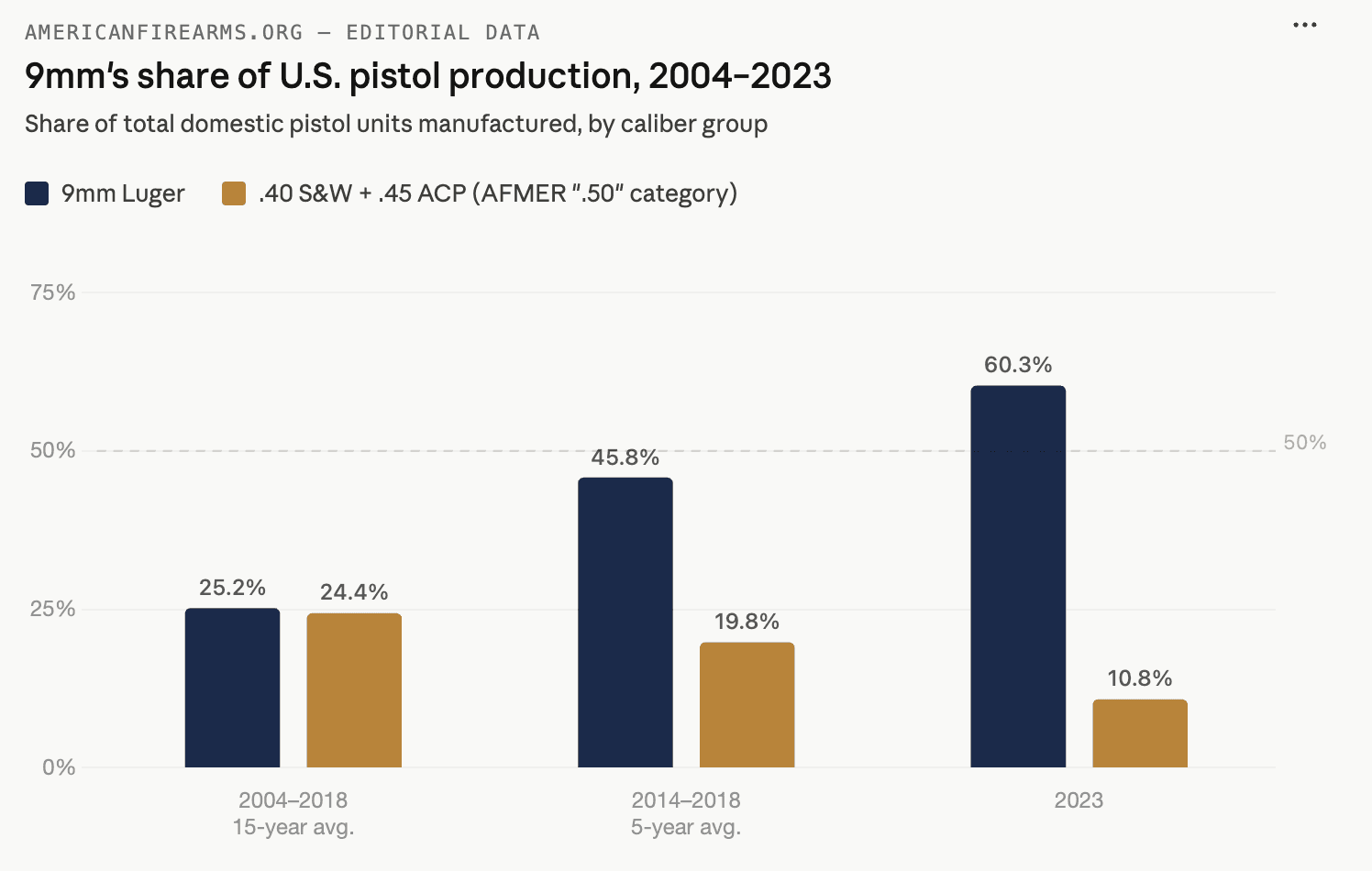
The ATF’s Annual Firearms Manufacturing and Export Report shows the arc clearly. In the 15-year average from 2004 to 2018, 9mm pistols represented 25.2% of total U.S. pistol production. In the 5-year average from 2014 to 2018, that number was 45.8%.
By 2023, the most recent AFMER data available, 9mm pistols totaled 2,375,628 of the 3,939,517 pistols manufactured in the United States — 60.3% of all domestic pistol production. The manufacturing market reached the same conclusion the Ballistic Research Facility had reached in 1989. It just took a generation to get there.
The Counterargument That Almost Works
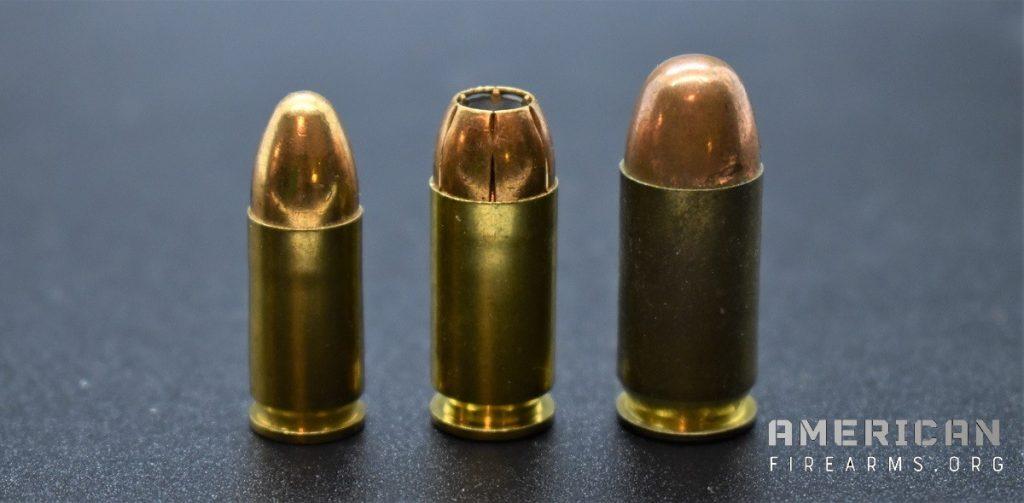
The strongest objection to calling this “always marketing” is partially correct, and the piece that ignores it doesn’t deserve to be believed.
Early 9mm ammunition was genuinely worse. The 115-grain ball loads and first-generation 147-grain subsonic JHP rounds of the 1980s had documented failure modes: inconsistent expansion, velocity loss from short barrels, shallow penetration in intermediate barriers. The .40 S&W was a real engineering response to a real performance gap. The Miami shootout revealed a penetration failure; the ammunition that followed was designed to address it. Calling all of this marketing dismisses a legitimate technical problem.
What it doesn’t do is rescue the caliber war.
The FBI’s 1987 Wound Ballistics Workshop was conducted with that era’s ammunition. The finding — that the .45’s advantage was marginal — came despite those early 9mm limitations. The 1989 report’s framework for evaluating terminal performance — penetration first, permanent cavity second, temporary cavity irrelevant — doesn’t change with ammunition technology.
What changed was that modern bonded projectiles, commercially prevalent by roughly 2007 per the FBI’s own accounting, eliminated even the marginal gap. The ballistic framework was correct from 1987 onward. The technology caught up. But the marketing had twenty years of head start by then, and markets move slower than labs.
The other part of the counterargument — that .40 S&W was a rational institutional response to the Miami shootout — is also true, and also not the point. The FBI needed to respond to the deaths of two agents.
That response was political as much as ballistic. You cannot tell an institution that has buried its people that the caliber didn’t matter. What the FBI could have done, and didn’t, was insist that the ammunition manufacturers compete on terminal performance per the 1989 framework rather than on caliber designation. The industry would have adapted. The caliber war might have been shorter.
What to Actually Do With This
The argument’s practical conclusion is not “caliber doesn’t matter.” It’s that the variable most people are optimizing — the number on the box — is the wrong one.
The FBI’s terminal ballistics standard is the right place to start. A defensive load must reliably penetrate 12 to 18 inches in 10-percent bare ballistic gelatin. The premium 9mm defensive loads that meet this standard — Federal 124-grain HST, Speer 124-grain Gold Dot, Winchester 147-grain Ranger T, Hornady 135-grain Critical Duty — perform identically to their .40 and .45 equivalents in gelatin, and the FBI’s own 2014 testing showed that.
A carrier with Federal 124-grain HST has not made a compromise. They’ve made a choice that the FBI’s Ballistic Research Facility would endorse.
The follow-on choices matter more than caliber selection. More rounds in the magazine means more opportunities to make accurate hits — and the 2014 memo is blunt about why that matters: “law enforcement officers on average strike an adversary with only 20 to 30 percent of the shots fired during a shooting incident.”
With modern ammunition, every round of capacity that 9mm provides over a comparable .45 is a real tactical asset, not an abstract number. Less recoil per shot means faster, more accurate strings. Lower cost per round means more practice. Those are the advantages a carrier actually uses. The best 9mm pistols on the market today — compact enough to carry, reliable enough to trust — reflect exactly this logic in their design.
If you carry a 1911 in .45 ACP and it runs flawlessly and you shoot it well, this argument changes nothing about your gun. A .45 ACP Federal 230-grain HST passes FBI penetration protocols. The argument isn’t that the .45 ACP is wrong; it’s that the performance case for choosing it over 9mm — specifically, the claim that you’re getting meaningfully better terminal ballistics — was never supported by the FBI’s own data, even in 1987.
The debate about whether 9mm is “enough gun” was settled before the question became fashionable. The answer is yes, with the right load. It was always yes, with the right load. What was never yes was the premise that the caliber designation on the headstamp was the variable that mattered.
What It Was Always About
The ammunition industry built the caliber debate because the caliber debate was profitable. A carrier who believes .45 ACP is meaningfully more effective than 9mm will buy more expensive ammunition, pay the premium for larger-caliber pistols, and feel a tribal identity in the choice that makes switching feel like a concession.
That’s a durable market.
Premium ammo for three calibers in active competition outsells premium ammo for one caliber that everyone agrees on.
The Ballistic Research Facility’s researchers were not naive about this. The 1989 report is measured in its language, methodical in its citations, careful not to overstate. But the conclusion is plain: the debate was never about ballistics.
It was about institutional inertia, marketing incentives, and the human need to believe that the gear we carry is the best gear — not merely adequate gear, correctly chosen.
The 9mm’s rise to 60% of American pistol production didn’t happen because shooters suddenly discovered the FBI’s 1989 report. It happened because ammunition technology caught up to a conclusion the lab had already reached, and the market, finally, followed the science.
The FBI’s Ballistic Research Facility was right in 1989. The manufacturing market is right now. The only thing that was ever wrong was the debate itself.
Primary sources
- FBI Training Division, “Justification for Law Enforcement Partners: Caliber, Ammunition Selection” (2014)
- FBI Ballistic Research Facility, “Handgun Wounding Factors and Effectiveness” (1989)
- ATF Annual Firearms Manufacturing and Export Report (2023)
- NSSF Industry Intelligence Report, “Firearms Production in the United States” (2020 edition, reporting 2018 data), available to NSSF members at atf.gov/resource-center/data-statistics.
Sign up for our newsletter
Get discounts from top brands and our latest reviews!
View by Category

In-Hand Reviews

Firearm News

Featured Comparisons

Firearm & Ammo Reviews

Popular Guides & Stats


Range Gear & Accessories

Gun & Ammo Safes